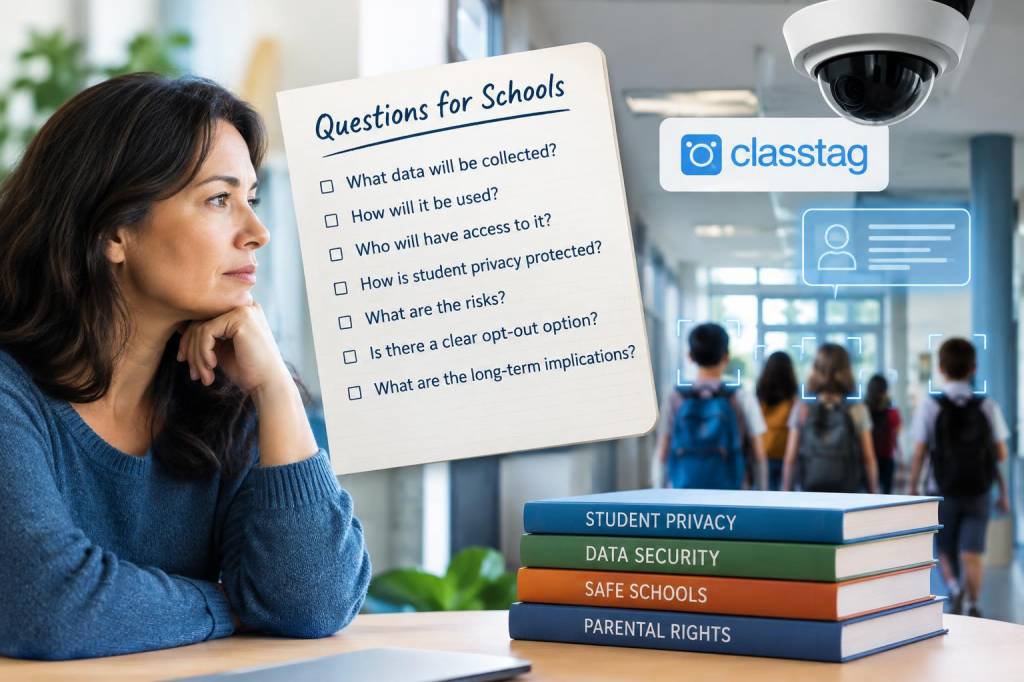
I remember the first time I walked into a parent-teacher meeting and saw a slide about a new app the district wanted to roll out. It promised “streamlined communication” and “improved student safety.” It sounded helpful — until I asked the obvious follow-ups and realized nobody had answers about what data the app collected, who could see it, and how long it would be kept. That moment stuck with me. As a parent and as someone who follows tech policy closely, I want other families to go into these conversations informed and ready.
Why parents should care about surveillance tech in schools
School vendors today offer much more than gradebooks and messaging tools. Many products—from attendance trackers and parent communication apps like ClassTag to classroom cameras, AI proctoring systems, and behavioral analytics platforms—collect fine-grained data about students’ activities, locations, devices, and even emotional states. That data can be useful, but it also creates privacy risks, security risks, and long-term consequences that families rarely see discussed in public meetings.
Before a district adopts anything that monitors students, parents should be able to understand what’s being collected, why it’s needed, and what safeguards are in place. Below are the concrete questions I would ask — and the kinds of answers I’d expect to hear.
Core questions to ask vendors and school leaders
- What problem does this product solve? Ask for a clear, specific purpose. If the answer is vague (“improves engagement”), ask for measurable outcomes and pilot study results.
- Exactly what data is collected? Names and IDs, attendance logs, GPS location, video/audio, keystrokes, browser history, facial recognition templates, behavioral scores, or metadata? Get a full inventory.
- How is the data used? Who uses it (teachers, administrators, third-party analysts), and for what decisions? Is data used to automate decisions about discipline, special education, or academic tracking?
- Who has access to the data? Is access restricted to certain staff with training? Do third-party vendors, subcontractors, or cloud providers have access? Are parents and students able to see their own data?
- How long is data retained? Weeks, years, indefinitely? Is there a policy for deleting student data when a student leaves the district?
- Is there a data minimization policy? Does the product collect only what's necessary for its purpose, or does it hoard ancillary information?
- Does the vendor share or sell data? For advertising, research, analytics, or monetization? Is data de-identified before sharing, and how robust is that de-identification?
- What security measures protect the data? Encryption at rest/in transit, multi-factor authentication, access logs, breach notification timelines, and independent security audits.
- Has the product undergone independent privacy or civil rights reviews? Ask for privacy impact assessments (DPIAs), third-party audits, or ethics reviews, especially for tools using AI or facial recognition.
- Can families opt out, and what does opt-out look like? Is there a meaningful alternative for students whose families decline? Will opting out curtail access to core educational resources?
- How are teachers trained to use this technology? Are there guidelines to prevent misuse (e.g., over-surveillance, punitive use of data)?
- What contractual protections are in place? Look for clauses on data deletion, breach liability, audit rights, and restrictions on data use.
Specific follow-ups for popular vendor features
If the product includes any of these capabilities, drill deeper:
- Messaging and contact lists (e.g., ClassTag-style apps) — Confirm whether message metadata or contact lists are sold or used to build profiles. Can parents control what is shared?
- Location tracking — Ask how precise the location data is, how often it’s sampled, who sees live location, and whether it could be accessed by law enforcement.
- Video/Audio recording — Where are recordings stored? Who can watch/listen? Are recordings used only for safety or also for teacher evaluation?
- AI-driven behavior scoring or facial analysis — Insist on evidence of accuracy and fairness. Ask about false positive rates, known biases, and independent validation.
- Remote proctoring/assessment monitoring — What data is captured (screen video, webcam, typing patterns)? Is it stored long-term? How are false accusations handled?
What to look for in vendor contracts and privacy policies
Most families won’t get copy of the vendor contract, but you can ask district leaders to publish key terms or a parent-friendly summary. Here are useful contractual items to request:
| Data ownership | Explicit language that the district (or students/families) own student data—not the vendor. |
| Purpose limitation | Contractual restriction that data may only be used to provide the educational service and not for advertising or product development. |
| Data deletion | Clear timelines and mechanisms for deleting data when no longer needed or when a student leaves the district. |
| Audit rights | District and independent third-party audit rights to verify compliance with privacy and security terms. |
| Subprocessor disclosure | List of cloud providers or subcontractors and commitments to notify before changes. |
| Liability and breach response | Vendor liability limits, breach notification timelines, and remedies for data misuse. |
How to push for transparency and accountability
From my experience covering tech policy, transparency is the single most effective lever parents have. Here are practical steps you can take:
- Request a public Q&A or privacy impact assessment — Ask the district to publish a plain-language DPIA before adoption.
- Form a parent-technology advisory group — Parents, teachers, and students can review tools and propose safeguards.
- Push for pilot programs with evaluation metrics — Insist on short pilots, measurable outcomes, and sunset clauses if benefits don’t materialize.
- Demand opt-out alternatives — Essential services should not be contingent on invasive tracking; students should have reasonable alternatives.
- Engage local media and school boards — Public scrutiny often prompts clearer policies and better vendor terms.
Questions to ask your child about how the tech feels
Finally, the human side matters. Kids notice what makes them uncomfortable long before policy teams do. Ask your child:
- Do you feel like someone is watching you when you’re learning?
- Have you ever been singled out because of something the system flagged?
- Do you understand what the app or tool does and why the school is using it?
- Would you prefer a different way to get help or communicate with teachers?
When I talk to parents now, I try to equip them with language and a checklist they can use at school meetings. Technology can genuinely help education, but only when it’s adopted with full awareness of trade-offs and with strong guardrails for privacy, equity, and security. Ask the questions. Demand clarity. And keep the focus where it belongs: on learning and on children’s long-term wellbeing.