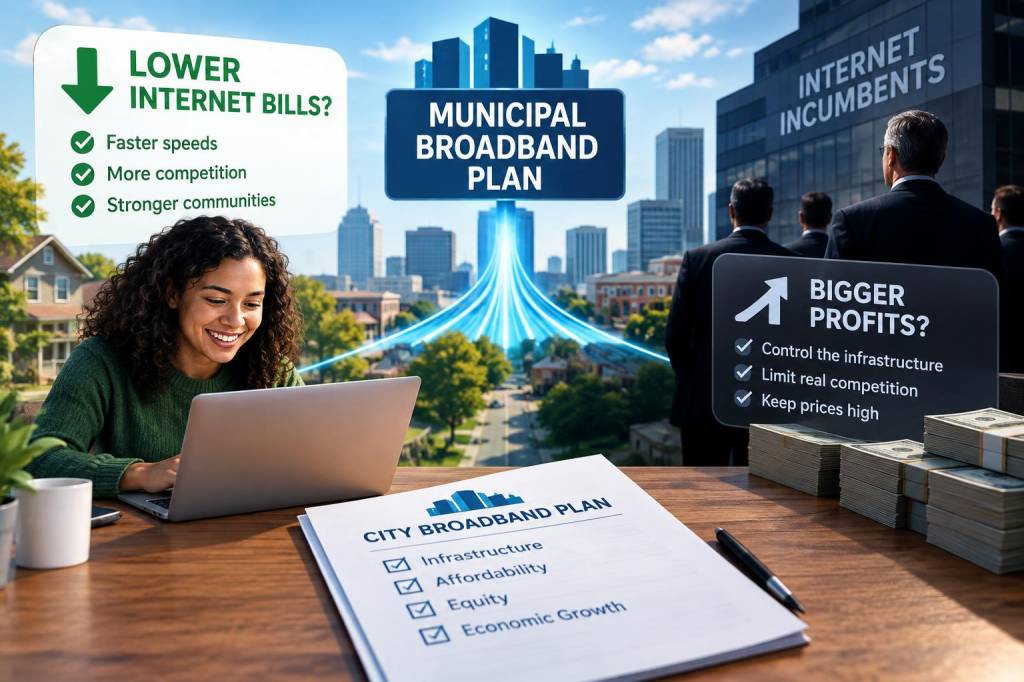
I’ve spent years watching local governments promise lower bills, faster internet, and an end to “monopoly” broadband — and I’ve learned to read the fine print before believing the headlines. Municipal broadband can cut bills and improve service, but it can also be structured in ways that funnel profits to incumbent providers or leave cities with sunk costs and unhappy taxpayers. Here’s what I look for when I evaluate whether a city’s plan is likely to help residents or simply enrich existing providers.
Why cities pursue municipal broadband
When I cover these stories, the starting point is usually the same: residents frustrated with slow speeds, high prices, or poor customer service. Cities pursue municipal broadband to address three common problems:
Those are legitimate motivations. The question is whether the policy choices made by city leaders — the financing, the network model, and the contractual terms — actually deliver on them.
Four common models, and what they tend to mean for bills
Not all municipal broadband is the same. Here’s a simple way to differentiate plans:
| Model | Who builds/owns? | Likely effect on prices | Downside risk |
|---|---|---|---|
| Municipal utility (city owns and operates) | City government / public utility | Often lowers prices over time, especially if run as a non-profit | Upfront cost; risk if demand projections are wrong |
| Public-private partnership (P3) | Private company builds and operates under contract | Mixed — can lower bills if contract enforces service/price goals | Contracts can favor private partner; revenue guarantees may subsidize incumbents |
| Open-access network | Public or neutral host owns fiber; multiple ISPs compete | Best potential to drive down prices through competition | Requires sophisticated governance to manage wholesale market |
| Cooperative or community-led | Local co-op or foundation owns network | Often affordable and community-centric | Scale and expertise can limit rollout speed |
My experience suggests the models most likely to reduce consumer bills are municipally owned utilities and open-access networks, because they prioritize service over profit and invite competing retail providers. P3s can succeed, but only if contracts are structured to preserve competitive pricing and public control over key terms.
How incumbents can end up enriched
There are several ways a plan intended to help residents ends up fattening incumbent providers’ margins instead:
These mechanisms aren't always obvious from campaign rhetoric. I always request and read the actual contract documents, franchise agreements, and financial projections to see where the incentives lie.
Key questions to ask about any plan
If your city is debating a municipal broadband plan, here are the hard questions your local reporters should be asking (and you should demand answers to):
Real-world examples that illustrate the trade-offs
Chattanooga’s EPB is often cited as a success story: a municipally owned electric utility that invested in fiber and offered 1 Gbps service at competitive prices. The network boosted local business, attracted tech investment, and — crucially — remained under public control, allowing the city to prioritize access and economic development.
By contrast, some cities that pursued P3s or sold assets have seen less impressive outcomes. In a handful of cases, private operators under-delivered on promised rollout timelines or used complicated fee structures that left consumers paying more than expected. When I dig into those contracts, revenue guarantees and limited competition are often to blame.
Practical tips for residents and local leaders
From reporting and advising municipal officials, I’ve collected a short checklist that helps separate sincere attempts to lower bills from plans likely to enrich incumbents:
What success looks like — and how long it takes
Municipal broadband isn't a magic wand. Successful networks typically take several years to reach scale; upfront costs are real; and getting governance right matters more than flashy launch events. But when cities align incentives — public ownership or neutral wholesale access, transparent contracts, and a focus on affordability — the results can be transformative: lower bills, better service, and broader access to broadband as an essential utility.