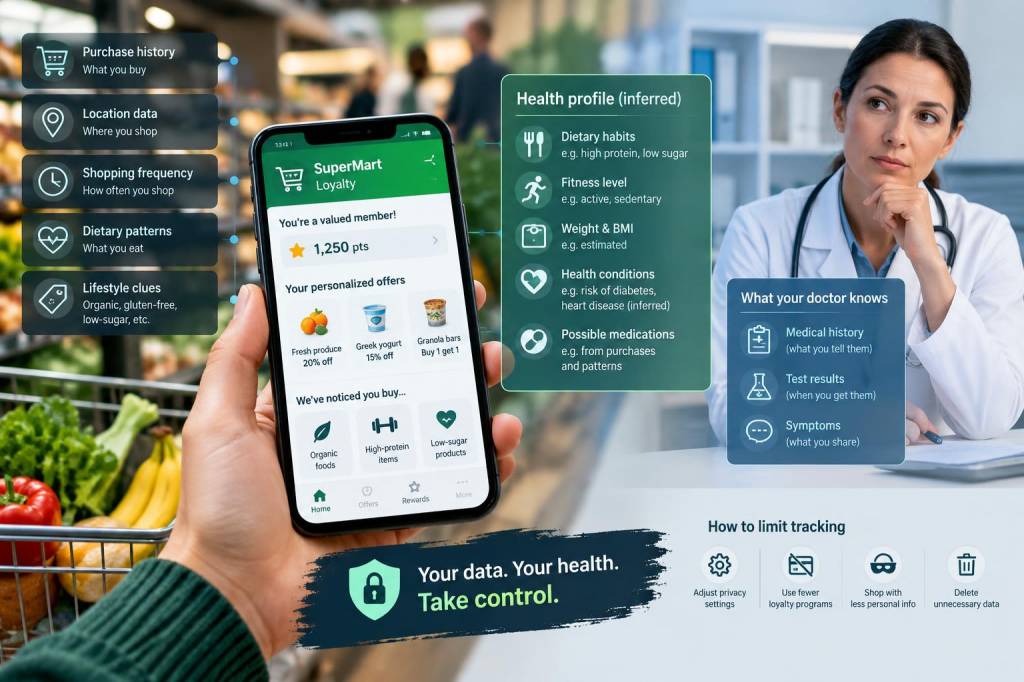
I started paying attention to supermarket loyalty apps the same way many of you probably did: a few pounds off a shopping trip, a personalized coupon that feels a little too on-point, and the convenience of scanning a barcode instead of rifling for a paper card. What creeped me out more was the moment I realized those perfectly timed offers weren’t just about snacks or detergent. They mapped my life — my diet, my medication, even when I might be pregnant — and in many cases they knew more about my health patterns than my GP does.
How grocery apps build a health profile
Loyalty programs are not just marketing tools; they’re sophisticated data-collection platforms. When you scan a loyalty card or use an app at the checkout, the retailer records every purchase and links it to your account. Over time, that purchase history becomes a detailed ledger of your habits. Combine that with other data points — loyalty cards tied to payment cards, pharmacy purchases, online orders, in-app browsing, and geolocation — and you’ve got a surprisingly precise picture.
Here are the main ways supermarket apps infer health information:
Put together, these strands allow retailers to build predictive models. It’s not just what you bought last week; it’s what you’re likely to need next month. The algorithms can even flag life events — like pregnancy — well before you tell anyone.
Why supermarket data can beat the doctor's view
Doctors get snapshots: the symptoms you mention, the test results they see, the prescriptions written. They don’t generally see your weekly shopping basket. Retailers, by contrast, see longitudinal behavior at high frequency. That difference matters.
That’s not to say doctors don’t have privileged data — they do, particularly clinical test results and diagnoses. But the supermarket’s continuous behavioral lens fills in gaps that healthcare encounters miss.
What retailers do with this health-related data
There are legitimate uses: personalized offers can help customers save money on necessary medical supplies, or nudge healthier choices. But there are also commercial incentives that are less benevolent. Retailers and their marketing partners sell insights to advertisers and data brokers, or use them to design targeted campaigns that increase spending. And once inferred health attributes enter data marketplaces, they can be used in ways you never intended — insurance risk scoring, targeted political ads, or undesired profiling.
How accurate are health inferences?
Pretty accurate — and worryingly confident. Machine learning models trained on large purchase datasets can identify patterns correlated with health conditions with high precision. Privacy protections like anonymization often fail because so many data points can be re-linked to an individual. A single loyalty account tied to a phone number or email is usually enough to re-identify anonymized records.
Practical steps to limit tracking
I’m not suggesting you throw away your loyalty card and go back to analogue life (though that’s an option). Instead, here are realistic steps that have helped me and the people I spoke with:
What to ask your supermarket — and your regulator
If you want change at scale, it helps to ask directly. When I’ve contacted retailers, I asked three simple things:
Regulators matter too. Under GDPR in Europe, people can request access to their data and demand erasure. In the U.S., laws are patchy; California’s CCPA gives some protections but nationwide rules are inconsistent. Pushing for clearer limits on using inferred health data for commercial profiling is important — this is not a problem that individual action alone will fix.
Risk trade-offs and personal choices
There’s a trade-off between convenience and privacy. I still use loyalty programs sometimes because the savings add up and I appreciate informed discounts. But I’m more deliberate: I separate my accounts, use privacy-friendly payment methods for sensitive items, and periodically purge data. That feels like a reasonable balance for me.
| Data Source | What it can reveal | How to limit |
|---|---|---|
| Purchase history | Diet, chronic conditions, pregnancy | Use guest checkout, separate payments |
| Pharmacy sales | Medications and treatments | Avoid linking pharmacy purchases to loyalty accounts |
| App permissions | Location, behavior, app use | Restrict permissions in settings |
| Cross-platform links | Full behavioral profile | Limit third-party logins and shared cookies |
Understanding that your grocery app knows more about your daily life than any single health professional is an uncomfortable but useful insight. It’s a reminder that data is power — and, unless we push back, commercial incentives will use that power in ways that don’t always align with our interests. That’s why small personal steps and bigger regulatory conversations both matter.