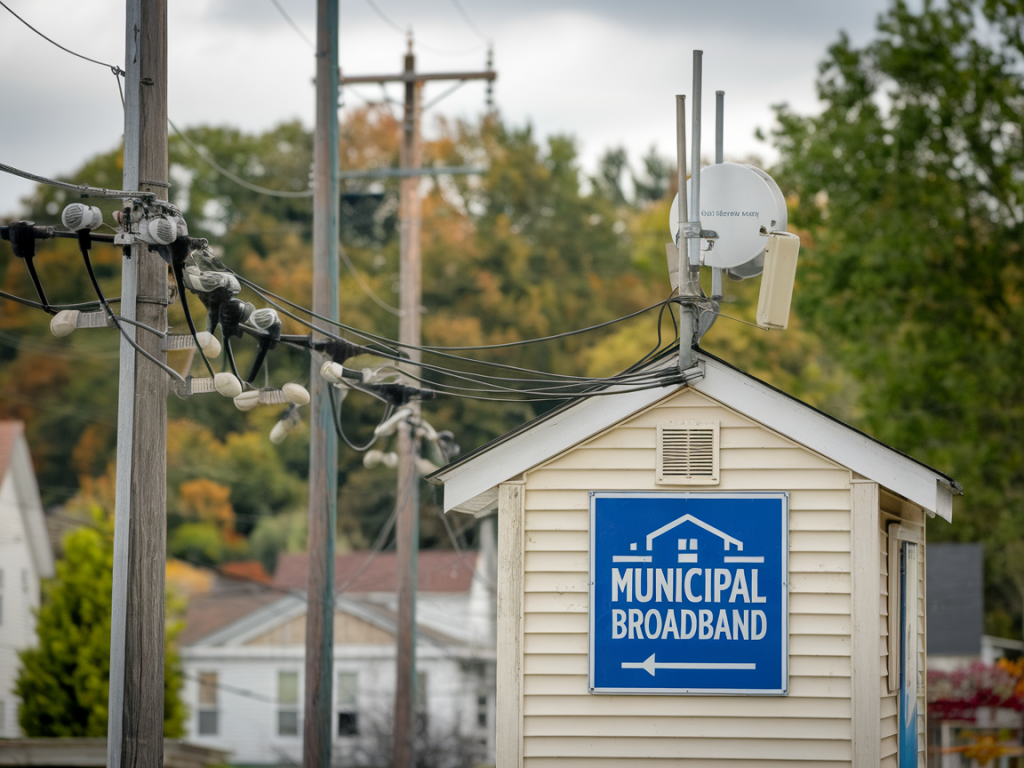
I remember the first time I rode past a municipal fiber hut and realized it wasn’t a tech startup but a public utility. That moment stuck with me: internet access is increasingly a core civic service, and when local governments decide to build networks, they don’t just add another option — they can fundamentally change the market dynamics that incumbents have long controlled.
Why cities build their own networks
When I talk to city officials and residents, three themes come up again and again: affordability, reliability, and control. For many communities, incumbent providers (think Comcast, AT&T, Charter) have left gaps — either in coverage of low-density areas or in pricing and service quality. Municipal broadband is a direct response to that problem.
- Affordability: Municipal networks often prioritize lower rates or more transparent pricing than large ISPs that bundle and upsell aggressively.
- Reliability: Cities can design networks to meet public safety and institutional needs (libraries, schools, police) with redundant routes and better customer support.
- Local control: Public ownership means decisions about expansion, open access, and net neutrality-like rules can be made locally rather than at corporate headquarters.
Take Chattanooga’s EPB Fiber in Tennessee. It started as an electric utility upgrade and turned into one of the first high-profile municipal fiber networks offering gigabit speeds. The result wasn’t only faster internet; it reoriented local competition and spurred economic development. That’s why municipalities consider building — to correct market failures and to capture economic and social benefits that a private provider might not prioritize.
How municipal projects actually challenge incumbents
Municipal networks change the incentives in a few practical ways:
- Price pressure: When a city offers a basic, reliable connection at a fair price, incumbents often lower rates or add promotions to retain customers.
- Service quality and innovation: Competition forces incumbents to deploy fiber upgrades or improve customer service where they previously had little impetus to invest.
- Policy leverage: A public provider can push for local ordinances that ease pole attachments, streamline permitting, or require open access to middle-mile infrastructure.
- Targeted deployment: Municipal networks can focus on underserved neighborhoods, forcing incumbents to reckon with digital equity rather than cherry-picking profitable suburbs.
In my reporting and conversations, I’ve seen incumbents respond differently: some engage constructively and accelerate upgrades, others lobby state legislatures to limit municipal broadband, and some simply lower prices in the short term while keeping long-term strategies unchanged. The key is that the competitive pressure exists — and that’s often enough to change outcomes for residents.
Models cities use — pros and cons
There’s no one-size-fits-all. I’ve looked closely at several approaches cities take, and each has trade-offs.
| Model | Description | Pros | Cons |
|---|---|---|---|
| Publicly owned, publicly operated | City builds and runs the network (e.g., EPB Chattanooga) | Maximum control, revenue stays local | High operational risk, requires telecom expertise |
| Public-private partnership (P3) | City partners with a private operator for build and/or ops | Shares risk, taps private capital and expertise | Complex contracts, potential long-term obligations |
| Open access | City builds fiber and rents capacity to multiple ISPs | Encourages competition at retail level | Requires careful wholesale pricing and governance |
| Utility plus retail | City provides backbone; private firms offer retail services | Reduces barriers to entry for ISPs | May not reduce prices without active competition |
Legal and political headwinds
One reality every city must confront is the political pushback. Telecom incumbents have significant lobbying clout. Over the past decade, several states passed laws restricting municipal broadband — limiting where cities can build, requiring referenda, or imposing financial hurdles. That’s why local political strategy is as crucial as engineering plans.
When I advise local journalists or community groups, I stress three tactics: document demand (surveys, petitions), build broad coalitions (libraries, schools, small businesses), and make the economic case clear (jobs, anchor institutions, competition). Those elements make it harder for state lawmakers to dismiss a municipal project as a niche or fringe initiative.
Funding options and financial prudence
Money matters. Municipal projects can be funded through bonds, public-private investment, federal and state grants, or utility reserves. The recent influx of federal funds — notably the BEAD program (Broadband Equity, Access, and Deployment) and ARPA allocations — has created a once-in-a-generation opportunity for cities to lower upfront costs.
But fiscal discipline matters. High-profile failures often stem from unrealistic take-rate assumptions, poor cost estimates, or aggressive expectations of short-term return. I’ve seen successful cases that modeled conservative adoption rates, phased deployment to limit capital exposure, and started with anchor clients (schools, hospitals) to stabilize early revenue.
Practical steps for a city considering a network
- Start with a realistic business plan: Engage independent consultants, run sensitivity analyses, and assume conservative take rates.
- Map demand precisely: Use surveys, ISP speed tests, and community meetings to prove both need and willingness to pay.
- Explore all funding sources: Apply for federal/state grants, consider bonds, and evaluate P3 models to share risk.
- Negotiate access: Secure agreements for pole attachments, conduit access, and right-of-way early to avoid delays and extra costs.
- Design governance for transparency: Create clear rules on pricing, open access, and conflicts of interest to maintain public trust.
- Plan phased deployment: Pilot in dense areas or serve anchor institutions first, then expand based on lessons learned.
Real-world lessons — what worked (and what didn’t)
From my conversations with municipal leaders, a few patterns emerge. Successful projects lean heavily on cross-departmental coordination — utilities, IT, procurement, and legal teams must work together. Cities that treated broadband as infrastructure (like water or electricity), with long-term maintenance plans and transparent accounting, fared better than those that treated it as a short-term economic development project.
Where projects stumbled, it was often because optimism outran planning: overestimated customer take-up, underestimated construction complexities, or failed vendor management. Another common pitfall: under-communicating with residents. Transparency around timelines, pricing, and potential disruptions builds trust and uptake.
Finally, there’s a strategic consideration: municipal networks don’t just provide service; they shift power. By guaranteeing a baseline of competition or open access, cities can force incumbents to invest where they previously did not. That shift is why incumbent pushback is so fierce: municipal broadband threatens not just market share, but a business model built on control of essential infrastructure.
If your community is exploring options, I’d encourage you to treat this as a long-term civic project — one that requires technical rigor, political savvy, and clear communication. The payoff isn’t only faster internet; it’s a civic asset that can support education, healthcare, small business, and civic life for decades.