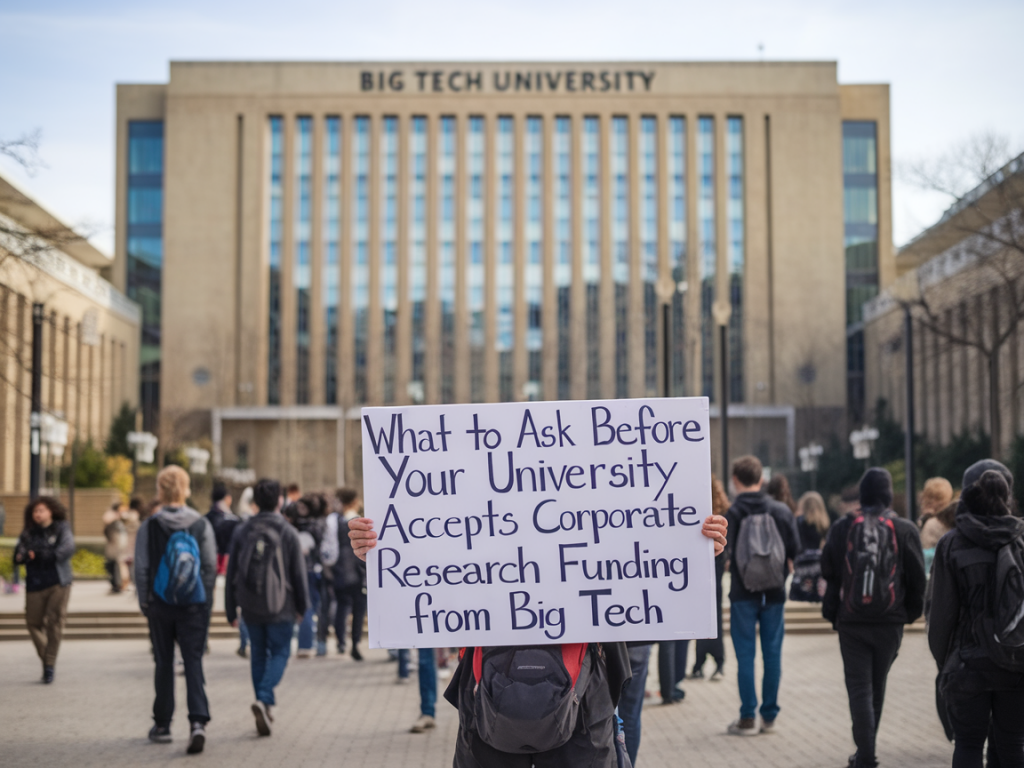
I remember sitting in a university meeting room where the research office was buzzing with a single question: should we sign the memorandum from a major tech company? The logo was familiar — Google — and the check was a six-figure banner promising resources, equipment, and access to proprietary datasets. It felt like an obvious win. But years of reporting on tech and policy have taught me to slow down and ask the practical, awkward questions that too often get buried under the handshake and the press release.
If you work at a university—faculty, administrator, student, or staff—here are the questions I would want answered before we let big tech fund research on campus. These are grounded in protecting academic integrity, preserving independence, and ensuring that public-good research doesn’t become stealth product development.
Who owns the research outputs?
Intellectual property is the clearest and most consequential area. You need to know whether the contract gives the company exclusive rights to patents, code, datasets, or even the right to commercialize findings.
I’ve seen agreements where companies insist on an initial review period to protect trade secrets — that’s reasonable in narrow circumstances. But blanket exclusivity or indefinite embargoes that prevent academic dissemination are a red flag.
Who controls publication and academic freedom?
Freedom to publish is a cornerstone of research. Any restriction — explicit or implicit — can undermine the university’s mission.
Ask specifically whether the company can block a publication citing “reputational harm” or “commercial confidentiality.” If the contractual language is vague, demand clearer guarantees for academic freedom.
What data are being used and who controls access?
Big tech companies can provide invaluable datasets — but access, provenance, and permissible use matter.
For example, partnering with Amazon or Meta may mean access to large user-behavior datasets. But if those datasets are collected under terms that don’t permit academic reuse or that violate local privacy laws, the university could be exposed to legal and ethical risk.
How will conflicts of interest be managed?
Faculty may have personal ties to sponsors: consulting gigs, stock, or advisory roles. Transparency and firewalls are essential.
Unchecked conflicts create perception and reality problems. A funded lab that becomes a recruitment pipeline for the sponsor can erode trust in the research produced there.
Who decides research scope and priorities?
Companies often have commercial aims that shape research agendas. That’s not inherently bad, but the university should retain agency.
If a sponsor is effectively setting the agenda, the work risks being product development in academic clothing. Contracts should preserve the university’s right to define research aims consistent with its mission.
What about student involvement and protections?
Students are often the ones doing the heavy lifting in labs. Their rights must be explicit.
I’ve met graduate students who later discovered their dissertation data were part of a proprietary product. Make attribution, authorship, and IP expectations clear up front.
How transparent is the relationship to the public?
Universities are public trust institutions. Disclosure matters.
Some universities keep sponsorship details hidden citing confidentiality. That should be the exception, not the rule. Public universities, especially, have a duty to disclose who is funding what.
What are the long-term dependency and strategic risks?
Large, multi-year deals can reshape a department’s priorities and budgetary dynamics.
It’s tempting to take sustained funding for computational infrastructure from a company like Microsoft or Google Cloud. But count the recurring costs and vendor lock-in risks. Who pays for maintenance once the initial grant dries up?
Does the research have dual-use or downstream harms?
Research into advanced AI, synthetic biology, or surveillance technologies can be used in ways that conflict with public interest.
Partnerships with firms such as OpenAI, Meta, or Palantir need careful thought about who ultimately deploys the outcomes and for what purpose.
What are the financial and administrative details?
Small print can hide big costs or obligations.
Universities must ensure that the deal covers true costs — administrative burden, ethics reviews, data security, and long-term stewardship — rather than subsidizing corporate R&D at a loss.
Who enforces compliance and what remedies exist?
Agreements must include clear enforcement mechanisms and exit clauses.
Contracts that bind the university into arbitration clauses favoring the corporate partner, or that limit legal recourse, should be renegotiated.
Questions you can ask the sponsor directly
In meetings, you can be straightforward without burning bridges. Here are lines I’d use:
These are practical, not hostile, questions. A reputable sponsor will expect them and have answers. A defensive or secretive response is itself telling.
| Issue | Good Contract Practice | Red Flag |
|---|---|---|
| Publication | Unfettered right to publish; limited, short embargoes for IP review | Indefinite or company-controlled publication veto |
| IP | University retains academic IP; clear licensing terms for commercialization | Company receives exclusive ownership of all outputs |
| Data | Clear provenance, documented consent, academic access rights | Company controls data access; revocable at will |
| Transparency | Public disclosure of funding and contract summaries | Confidentiality clauses that hide material terms |
As someone who aims to make complex conversations clear, I’ve learned that saying “no” or “not yet” is a defensive strength for universities. The goal isn’t to reject industry collaboration — many partnerships deliver social benefits and accelerate innovation — but to ensure those collaborations don’t quietly reorient academic priorities or silence inconvenient truths.