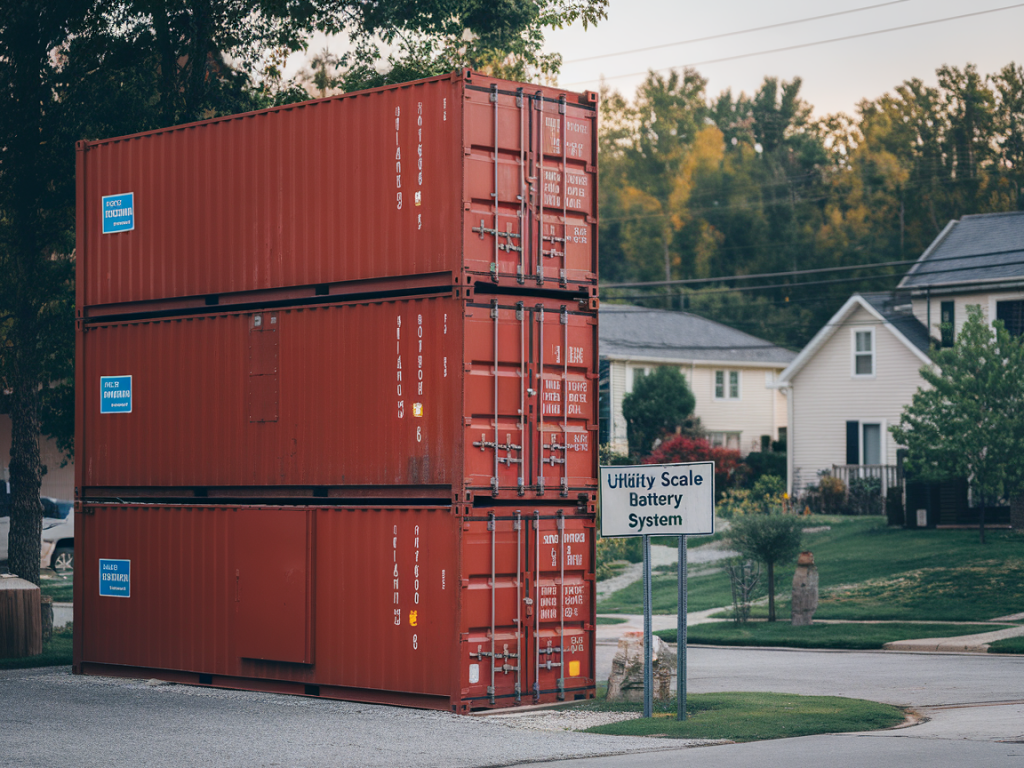
I first noticed the tension between big battery projects and everyday EV drivers while reporting on a suburban town council meeting outside Boston. Residents were excited about a new public fast charger that would make longer trips and local errands easier. Then the utility announced plans to connect a utility-scale battery to the same neighborhood grid — and suddenly that fast charger was delayed for months because the utility prioritized the battery installation. The meeting turned into a debate about priorities: decarbonization at scale versus practical charging access for residents. That experience pushed me to dig into why utility-scale batteries, which many environmental advocates cheer, are sometimes slowing down EV charging rollouts in the places they’re most needed.
What do we mean by “utility-scale batteries”?
Utility-scale batteries are large energy storage systems, often lithium-ion but increasingly including flow batteries or other chemistries, connected directly to the transmission or distribution grid. They can store megawatt-hours of electricity and provide services like peak shaving, frequency regulation, and backup power. Companies like Fluence, Tesla (with its Megapack), and newcomers to the storage market sell these systems to utilities and independent power producers.
Why are utilities building them?
Utilities have several incentives to deploy big batteries quickly:
So why do they slow EV charger rollouts?
There are practical, regulatory, and market reasons — and they often collide in suburbs where infrastructure is older and demand for residential EV charging is growing fastest.
1. Permitting and interconnection bottlenecks
Both utility-scale batteries and EV chargers need permits and interconnection studies. When a large battery project applies for interconnection, the utility’s engineers focus resources on that single, complex file. That can delay smaller projects like DC fast chargers or even aggregated residential charger programs. Interconnection queues in many states are already long; a megawatt-scale battery can move to the front because it promises grid benefits and revenue streams, while a charger project that serves a handful of vehicles looks less urgent on paper.
2. Capacity allocation and distribution upgrades
Utilities plan upgrades based on where they forecast demand. A big battery can be positioned to address a predicted capacity shortfall and is often counted as a flexible resource that reduces the need for costly line upgrades. Once a battery is planned for a feeder, utilities may deprioritize other investments like adding transformers or reconductoring lines that would enable multiple high-power chargers in neighborhoods. The battery solves one set of problems (peak loads, renewables smoothing) but doesn’t always free up headroom for distributed, high-power loads like EV fast chargers.
3. Rate design and cost recovery incentives
Utility business models matter. Utilities recover costs through regulated rates and seek capital projects that regulators will approve. Utility-scale battery projects are often framed as grid investments with clear revenue mechanisms. By contrast, EV charging infrastructure is sometimes owned and operated by third-party companies (ChargePoint, Electrify America, Tesla Superchargers) or municipalities, which complicates cost recovery. Utilities may be less inclined to prioritize distribution work that benefits third-party chargers unless policy or regulatory frameworks explicitly support it.
4. Grid operational priorities
From an operational perspective, utilities may want batteries in strategic locations that maximize network benefits — frequently at substations or critical feeders — rather than at every neighborhood corner. That decision can shift where upgrades occur and who gets priority for available capacity. In practice, a battery might be sited to stabilize voltage across a wide area, while a cluster of suburban chargers on a laterally loaded feeder gets postponed.
What common questions do readers have?
Will a battery reduce the need for more electricity? Not really. Batteries shift when electricity is used; they don’t reduce total demand. That means if many residents charge EVs during the evening, storage can supply some of that demand, but there’s still a need for distribution capacity and local infrastructure upgrades.
Can batteries and chargers coexist? Yes — but coordination is crucial. Smart planning can allow batteries to absorb and discharge in ways that accommodate high-power charging events. That requires communication between utilities, battery operators, charger companies, and municipal planners, and often a regulatory framework that encourages shared benefits.
Are batteries bad for EV adoption? No. Batteries provide essential grid services that support higher penetrations of renewables and electrification overall. The problem is that short-term planning and misaligned incentives can make batteries crowd out immediate investments in charging infrastructure, slowing adoption in the places where daily drivers need it most.
Examples from the field
In California, utilities have accelerated storage projects to meet wildfire and reliability concerns, and some local municipalities reported delays in approving fast-charging sites because distribution upgrades were being reserved for those storage assets. In the U.K., planners have flagged similar trade-offs as large-scale batteries cluster near substations and push smaller local projects down the queue.
What can policymakers and utilities do?
There are several policy and operational fixes that can help align battery deployment with EV charging needs:
What residents and local leaders can do
If you live in a suburban neighborhood waiting for chargers, there are practical steps you can take:
When I cover infrastructure debates, I try to focus on trade-offs and concrete fixes rather than narratives that pit technology against technology. Utility-scale batteries are an important tool for decarbonization and reliability, but they’re not a substitute for deliberate planning that ensures everyone — from a neighborhood commuter to a long-haul EV driver — can access the charging they need. The solution isn’t choosing one over the other; it’s designing systems and incentives so batteries and chargers become complementary parts of a cleaner, more resilient grid.