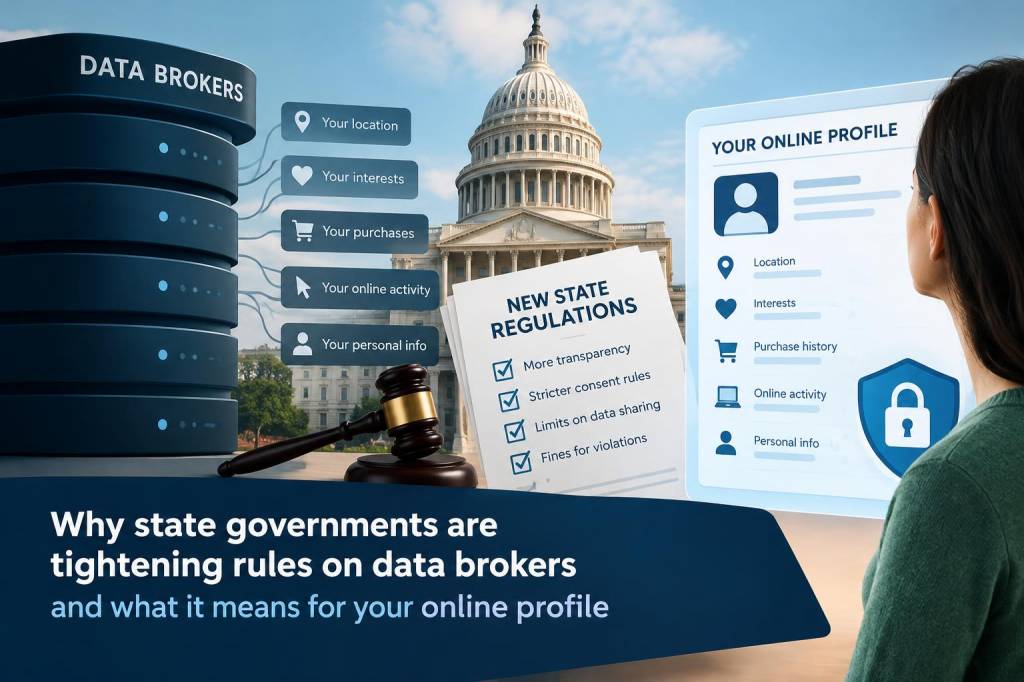
I have been watching state legislatures move on data broker laws with a mix of relief and unease. Relief, because a stronger grip on this industry feels long overdue. Unease, because every new rule also reveals just how much of our online lives have been quietly packaged, traded, and resold long before most of us even realized it was happening.
Data brokers sit in a strange corner of the digital economy. They do not usually meet you face to face, they do not need your password, and they often do not need to “hack” anything in the dramatic sense people imagine. Instead, they collect fragments from apps, websites, purchase histories, public records, loyalty programs, location data, and advertising networks. Then they assemble those fragments into profiles that can reveal where you live, where you work, what you buy, what you fear, who you might vote for, and where you tend to go on an ordinary Tuesday afternoon.
When state governments tighten rules on data brokers, they are usually responding to a simple reality: most people never gave meaningful consent for this kind of profiling. I know many readers think they already “opted in” somewhere, sometime, by clicking a box they barely saw. But consent in modern digital life is often a blur of dark patterns, endless pop-ups, and privacy notices written to be skimmed, not understood. State lawmakers are stepping into that gap because federal privacy law in the United States has been slow, fragmented, and incomplete.
Why states are acting now
From my perspective, the push is being driven by three forces at once. First, public awareness has grown. People now know that ads can follow them around the internet, that apps can infer sensitive details, and that data leakage is not limited to major breaches. Second, state attorneys general and privacy advocates have started connecting brokered data to concrete harms, including stalking, identity fraud, discrimination, and doxxing. Third, the political appetite for visible privacy action has increased as lawmakers look for ways to show they can protect residents without waiting for Congress.
I also think state governments see data brokers as a useful target because the industry is easier to define than the broader ad-tech ecosystem. A broker’s business model is simpler to explain: collect, combine, resell. That makes it easier to justify rules such as registration requirements, data deletion rights, disclosure obligations, and limits on selling certain categories of information. When legislators can point to a named industry and say, “This is what we are regulating,” policy moves faster.
In places like California, Vermont, Texas, Oregon, and others, lawmakers have already tested different approaches. Some states require brokers to register. Some give residents more control over deletion and opt-out requests. Some focus on sensitive data such as precise location, health-related information, or data about children. Each state is building its own version of privacy enforcement, and that patchwork matters more than people realize.
What these rules usually target
When I read a new state privacy bill, I look for a few recurring themes. They usually include:
- Registration requirements for companies that meet the legal definition of a data broker
- Clear notice about what data is collected and sold
- Rights for residents to access, delete, or opt out of sales of their data
- Extra protections for sensitive categories such as health, biometrics, precise location, or children’s data
- Limits on sharing data with certain third parties, including advertisers, background check firms, or location aggregators
- Enforcement powers for state agencies and penalties for noncompliance
These may sound technical, but they matter in everyday life. If a broker holds your location history, a bad actor may be able to infer where you sleep. If a broker holds your shopping habits, another company may decide you belong in a high-price segment. If a broker holds your political or health-related signals, you may be pushed into categories you never consented to join. The harm is not always dramatic. Often it is subtle, cumulative, and difficult to trace.
What this means for your online profile
When people hear “profile,” they often think of a social media page. I think of something much broader. Your online profile is the invisible version of you that lives inside databases, ad exchanges, customer relationship tools, and analytics dashboards. It may include your age range, income estimate, household composition, device type, commute habits, likely interests, and dozens of other inferred traits.
New state rules can make that profile less marketable and, in some cases, less detailed. If a broker must honor deletion requests more reliably, then fewer downstream buyers will have access to your records. If a state restricts the sale of precise location data, then advertisers and analytics firms may have less ability to track your movements across neighborhoods, stores, clinics, or places of worship. If a law forces clearer disclosures, you may finally learn which firms hold your information and why.
But I would be careful about promising that these laws will erase your profile entirely. They will not. Data can live in many places at once, and once it has been copied, resold, or integrated into another system, clawing it back is difficult. A state rule may remove one source of exposure, yet your data may still exist in advertising archives, app partner networks, loyalty systems, or old customer databases. That is why privacy law is only one layer of protection, not a magic switch.
Why this matters even if you think you have nothing to hide
I hear this argument constantly, and I understand where it comes from. Most people do not feel interesting enough for surveillance to matter. But data brokerage is not just about embarrassment or secrecy. It is about power, pricing, access, and vulnerability. A profile can influence what you see, what you pay, whether you are targeted with manipulative offers, and whether you are excluded from opportunities without ever knowing it happened.
That is especially important for vulnerable groups. Survivors of abuse may face stalking risks. Teens may be profiled before they can understand consent. People with health conditions may be targeted with exploitative ads. Journalists, activists, and public employees may be exposed to unwanted tracking. Even ordinary consumers can be affected when their inferred traits are used to decide credit offers, insurance pricing, or marketing segments.
I think the deeper issue is not privacy in the abstract. It is dignity. A person should not need a law degree to understand where their data goes. And a person should not need to live completely offline to keep a basic sense of control.
Why a state-by-state approach creates both progress and confusion
State action is powerful because it can move faster than federal law, but it also creates complexity. A broker operating nationwide may face different obligations in California than in Maine, Oregon, or Texas. A resident may have more rights in one state than in another. A company may choose to build one national compliance system that meets the strictest standard, or it may create a maze of location-based rules that users never see.
As a reader, I see the benefit and the frustration. The benefit is momentum. The frustration is inconsistency. Privacy should not depend on ZIP code. Yet until Congress passes a more comprehensive law, states will remain the main laboratory for experimentation. Some approaches will be stronger than others. Some will be clearer. Some will have better enforcement. Over time, I expect the strongest rules to shape the national norm, even if the path is uneven.
What I would pay attention to in a new law
When a state announces a new data broker rule, I pay attention to implementation details, not just the headline. The real question is whether the law has teeth. A nice-sounding right to delete data is less meaningful if the process is buried in confusing forms or if companies can ignore requests with little risk. A registration rule matters less if enforcement is sporadic. A sensitive-data ban matters less if exceptions swallow the rule.
Here are the details I find most important:
- Whether residents can submit requests easily, without jumping through multiple identity checks
- Whether companies must disclose data categories in plain English
- Whether opt-out rights cover resale, not just direct advertising
- Whether sensitive data receives stronger protection than ordinary commercial data
- Whether penalties are large enough to change behavior
- Whether the law covers indirect brokers and not only firms that openly call themselves brokers
That last point matters a lot. Some companies do not look like classic brokers, yet they still assemble and trade data in ways that feel very similar. If lawmakers define the category too narrowly, the industry simply shifts into adjacent labels and keeps operating. Real regulation has to follow the function, not just the branding.
What you can do right now
Even before every law is fully enforced, I think it is worth taking a few practical steps. I use them myself when I think about my own digital footprint.
| Action | Why it helps | My view |
|---|---|---|
| Review app permissions | Limits unnecessary location, contact, and device access | Simple and often overlooked |
| Use privacy request pages | Asks brokers to remove or limit your data | Worth the effort, even if imperfect |
| Reduce ad tracking settings | Weakens cross-app profiling | Not complete, but still useful |
| Check data broker registries | Helps identify firms that may hold your data | Good starting point for cleanup |
| Limit unnecessary loyalty and sign-up forms | Reduces direct data collection | Small habit, real effect over time |
I do not want to oversell individual action. No single person can outwork an industry built on scale. Still, I think personal choices matter when they are paired with stronger state rules. Privacy improves fastest when consumers, journalists, advocates, and lawmakers push in the same direction.
Why this story is bigger than advertising
It is tempting to think of data broker regulation as a niche tech story about ads and cookies. I think that misses the larger shift. This is really about whether we accept a business model built on invisible surveillance and mass inference, or whether we draw a line and say that some uses of personal data are simply too intrusive to normalize.
State governments are tightening rules because people are tired of being treated as raw material. That mood is changing the market, the law, and the language we use to talk about privacy. And as those rules expand, your online profile may become a little less exposed, a little less portable, and a little less available to strangers who never met you but already know far too much about your life.