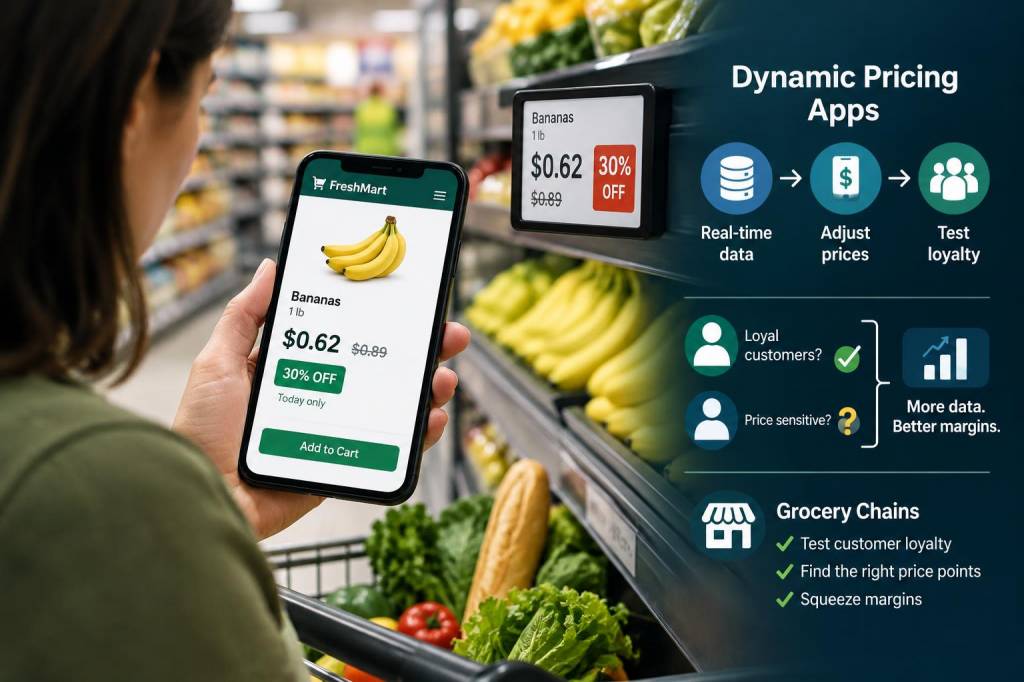
I keep seeing the same quiet experiment unfold across grocery aisles, shopping apps, and digital receipts: prices that seem to shift, rewards that seem to change shape, and promotions that feel a little more personal than they used to. What looks like a simple discount is often part of a much larger pricing system, one that grocery chains use to learn something valuable about me, about you, and about how much pressure our budgets can absorb before we walk away.
Dynamic pricing in grocery retail is not always dramatic in the way airline fares or ride-hailing prices can be. Most of the time, it shows up in smaller, subtler forms. A coupon appears in an app for one shopper but not another. A loyalty member gets a lower price on pasta this week, while someone else sees a slightly higher shelf tag. A digital promotion expires after a few hours, then returns in a new form two days later. When I look closely at these patterns, I see less about random discounts and more about controlled testing.
What grocers are actually testing
At its core, dynamic pricing is a way to adjust what shoppers see based on demand, inventory, time, location, and customer profile. Grocery chains want to know a few things at once: Will a customer buy at full price? Will they wait for a promotion? Will they switch brands? Will they stay loyal if a rival store offers a better deal nearby?
That is why the app has become so important. A grocery app is not just a digital flyer. It is a data collection tool, a personalization engine, and a pricing laboratory. Every tap tells a story. If I search for oat milk three times in a week, the chain learns I may be open to a targeted offer. If I repeatedly buy store-brand eggs but never organic ones, the retailer can infer my price sensitivity. If I redeem a coupon only when the discount reaches a certain level, that threshold becomes part of my profile.
From a business point of view, this is extremely useful. Grocery margins are thin, competition is intense, and inflation has made shoppers more alert than ever. Chains do not want to discount everything, because that would destroy margins. They also do not want to lose customers, because grocery shopping is habitual and repeat business matters. So they try to find the middle ground: offer just enough incentive to keep me coming back, while learning exactly how little they can give away.
Why loyalty programs are central to the strategy
Loyalty programs used to be simple. Collect points, earn rewards, save a little money. Now they often function as a gatekeeper to pricing itself. In many stores, loyalty is no longer just about extra perks; it can determine which price I see in the first place. That changes the relationship between retailer and shopper in a big way.
When I join a loyalty program, I give the store a steady stream of behavioral data. In exchange, I get access to digital coupons, app-only prices, and personalized offers. On paper, that looks fair. But the real question is whether the program is building loyalty or merely measuring my willingness to tolerate higher prices without leaving.
That tension matters because grocery chains are increasingly segmenting customers into groups. Some shoppers are treated as high-value regulars, worth rewarding aggressively. Others are seen as deal seekers, only likely to buy when the discount is deep. Still others may be categorized as convenient, low-friction shoppers who do not respond much to promotions. Once those categories are in place, the chain can tailor pricing to each group with surprising precision.
This is where the feeling of fairness starts to fray. If my neighbor gets a digital offer that I never see, I may not know whether I missed a lucky break or whether the store decided I did not need the nudge. That uncertainty is part of the system. It keeps shoppers guessing, which can make them check the app more often and accept the possibility that a better deal is always one click away.
Margins, inflation, and the pressure to optimize
Grocers are not inventing these systems just to be clever. They are responding to a harsh economic reality. Food retail runs on razor-thin margins, often less than many shoppers assume. Labor, transportation, energy, spoilage, and supplier costs all eat into profits. When inflation rises, chains face a dilemma: pass costs through to shoppers and risk backlash, or absorb them and watch margins shrink.
Dynamic pricing apps are one way to manage that squeeze. Instead of lowering prices across the board, retailers can target discounts where they are most likely to preserve overall sales. If a product is slowing down in one region, the app may push a deal there. If a shopper tends to buy premium brands, the store may discount only a related item to keep the basket value high. If inventory is too large on a perishable product, the chain may quietly encourage faster turnover through app-based incentives.
This approach can improve efficiency, but it also shifts risk onto consumers. We become the variable. Our habits become the data point. Our patience becomes something the store measures in real time.
| Retail tactic | What shoppers see | What stores are measuring |
|---|---|---|
| Targeted app coupon | Personal discount on selected items | Price sensitivity and product affinity |
| Member-only shelf price | Lower price after login or scan | Loyalty value and retention risk |
| Time-limited promotion | Deal that expires quickly | Urgency response and conversion rate |
| Inventory-driven markdown | Lower price on excess stock | Demand elasticity and waste reduction |
Why this feels different from ordinary discounting
I think many shoppers can accept a sale. What feels unsettling is the sense that prices may no longer be universal. Traditional sales were visible and shared: everyone saw the same flyer, the same weekend promotion, the same clearance sticker. Dynamic pricing can be far less transparent. Two people standing in the same store may not be looking at the same offer if their app data, loyalty status, or purchase history differs.
That difference matters because groceries are not luxury purchases. They are essential. When pricing becomes individualized in a category that most households cannot avoid, the power balance changes. A shopper can skip a vacation or delay buying a new phone. But no one can simply opt out of buying food.
As a result, dynamic grocery pricing raises a question that goes beyond economics: what kind of relationship do we want between essential retailers and the people who depend on them? If price becomes a moving target, then loyalty turns into a test rather than a reward. The store is no longer asking only whether I like it. It is asking how far it can go before I notice, compare, and leave.
Where this can help, and where it can backfire
I do not think dynamic pricing is automatically bad. In some cases, it can help shoppers save money on items they already buy, reduce food waste through smarter markdowns, and help stores stay profitable in a brutally competitive market. A well-designed app can make discounts easier to find and more relevant to real household needs.
But the same system can backfire if it becomes opaque or manipulative. If prices rise because a shopper appears less responsive to discounts, trust erodes. If essential goods are repeatedly targeted for selective markups, resentment grows. If the store makes it hard to know whether a price is genuinely fair, shoppers start assuming the worst.
That is why transparency matters so much. A grocery chain can test customer loyalty without treating customers like laboratory subjects, but only if it is clear about what is being offered and why. When I can understand the rule, I am more likely to accept the result. When the rule is hidden, even a small price difference can feel like a breach of trust.
What I watch for when I shop now
I have become more attentive to a few signals. A price that only appears after sign-in is not just a deal; it is a data exchange. A promotion that changes from one visit to the next may reflect demand testing, not generosity. A loyalty app that feels increasingly necessary for basic savings is often part of a larger pricing strategy.
- Prices that differ between app and shelf
- Coupons that appear only after repeated browsing
- Member pricing that applies to routine essentials
- Offers that change based on shopping frequency
- Promotions tied to store-brand switching
Once I started noticing these patterns, grocery shopping felt less like a routine errand and more like an ongoing negotiation. The store is not only selling food. It is also studying behavior, measuring loyalty, and trying to predict which margin it can protect without pushing me away.
That is the real story behind dynamic pricing apps in grocery retail: not just cheaper bananas or a surprise coupon for cereal, but a system built to test my habits, rank my value, and decide in real time how much discount is enough to keep me inside the ecosystem.