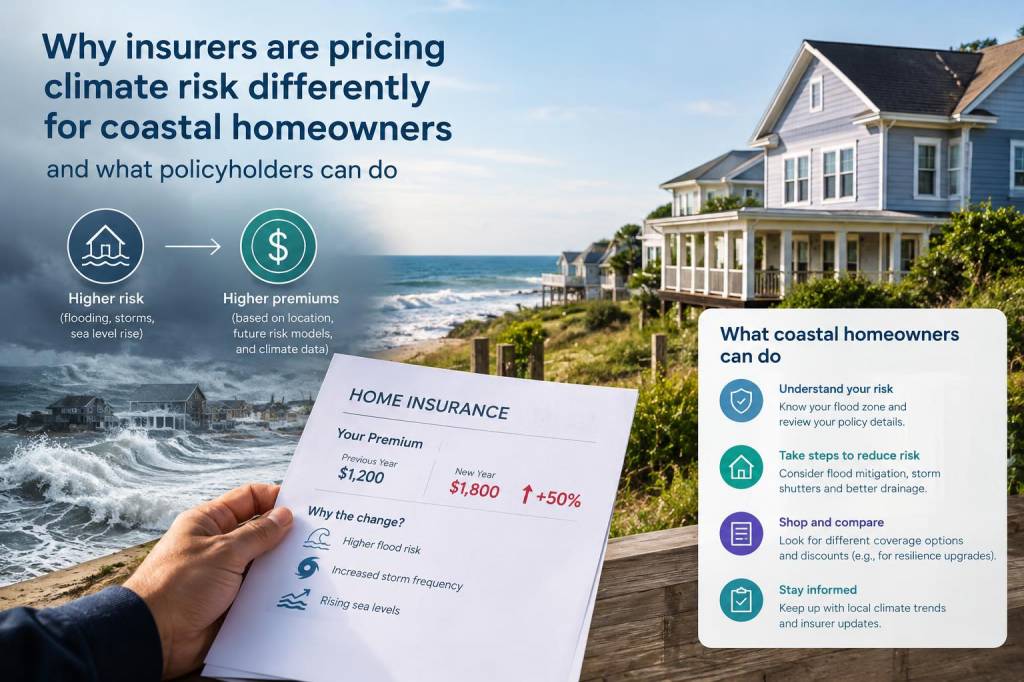
I have watched more homeowners become anxious about insurance letters, premium jumps, and reduced coverage after each severe storm season, especially along coasts. What used to feel like a routine renewal now feels like a stress test of household finances. If you own property near water, you may already know that your insurer no longer prices your home as if every address in a coastal ZIP code carries the same level of risk. That shift is real, and it is changing the way policyholders plan, protect, and sometimes even stay in place.
When I look at this issue, I see a simple truth: insurers are not just reacting to one hurricane or one flood. They are reacting to a longer pattern of loss. They study what happened in past storms, what is likely to happen in future seasons, and how much it costs to rebuild in places where wind, water, and erosion can strike again and again. For coastal homeowners, that means location is no longer a broad label. It is a highly specific risk profile.
Why coastal risk is now priced in a more precise way
Insurance companies have always priced risk, but climate change has made that calculation sharper and, in many places, harsher. A home a few blocks inland may face very different exposure from a home on a barrier island, even if both are in the same county. Elevation, distance from surge zones, roof shape, building materials, age of construction, drainage capacity, and local rebuilding costs all matter more than they once did.
I think many policyholders assume insurance is mainly about whether a house has ever been damaged. In reality, insurers look forward as much as backward. They use catastrophe models that estimate how often storms may hit, how intense they may become, and what a single event could cost across an entire region. If a coastal area has seen repeated claims, insurers may raise premiums, add higher deductibles, exclude certain losses, or withdraw from the market altogether.
This is one reason two neighbors can receive very different quotes. One may have a newer home with storm-resistant windows, a reinforced roof, and a higher foundation. Another may live in a house built before modern codes, with older plumbing, a lower elevation, and a roof that needs replacement soon. To an insurer, those differences are not small. They can change expected losses enough to affect pricing in a major way.
Why premium increases feel so uneven
From my perspective, one of the hardest parts for policyholders is that price changes rarely feel intuitive. A homeowner may say, “My property was fine last year, so why did my premium climb so much now?” That question makes sense emotionally, but insurance pricing is not only about your personal claims history. It is also about market-wide stress.
When reinsurance becomes more expensive, local insurers often pass that cost on. Reinsurance is insurance for insurers, and it matters a great deal in coastal markets because a single event can generate huge losses across many homes at once. If reinsurers charge more because they expect bigger climate-related losses, your bill can rise even if your own house has never filed a claim.
There is also a rebuilding-cost effect. Labor, materials, and permitting are more expensive after major disasters, and those costs do not stay isolated to the exact place where the storm hit. They spread across regions. So even if your risk has not changed dramatically in one year, the cost to repair your home after a future event may have gone up, and insurers price for that reality.
What insurers are looking at now
When I read through insurer disclosures and public filings, a pattern keeps showing up: companies are relying more on data, mapping, and property-level details. They want to know not just where a home sits, but how it sits. A house elevated above expected flood levels may be cheaper to insure than one at grade. A reinforced garage door may reduce wind loss. A newer electrical system may lower fire risk after flooding. Even landscaping and drainage can matter if they affect water intrusion.
Here are some of the factors that can influence pricing:
- Distance from shore and exposure to storm surge
- Elevation compared with flood maps and base flood levels
- Building age and compliance with modern code standards
- Roof condition and wind resistance features
- Flood mitigation such as vents, barriers, sump systems, and raised utilities
- Past claims history for both the home and the broader area
- Access to fire, flood, and evacuation routes
- Local repair costs and contractor availability after disasters
I find it important to say that this is not only a coastal story in a narrow sense. It is part of a broader change in how risk is measured across a warming economy. Still, coastal homeowners are often first to feel it because sea level rise, stronger storms, and repeated flooding create an unusually difficult combination for insurers.
What policyholders can do before renewal time
If you live near the water, I would not wait for a nonrenewal letter to start thinking about your coverage. The most practical step is to treat insurance like a yearly financial review, not a passive bill. Read your declarations page carefully. Know your wind deductible, your flood deductible, and any exclusions that may apply. If you do not understand a term, ask for a plain-language explanation from your agent or carrier.
You can also strengthen your position by documenting improvements. Keep receipts, permits, inspection reports, and photos for work that reduces risk. Roof replacement, impact-rated windows, elevation projects, sump pumps, backflow valves, and raised HVAC systems may not guarantee lower premiums, but they can help support a review or a new quote. In some cases, a few targeted upgrades make a larger difference than a broad but vague renovation.
I also think it helps to shop around early. Too many homeowners begin looking only after a nonrenewal notice arrives, which leaves little time and less leverage. Compare quotes from admitted carriers, surplus lines markets if appropriate, and, where available, state-backed options. Do not focus only on price. Look closely at coverage limits, deductibles, and what is actually excluded. A cheaper policy can become expensive fast if it leaves a large gap after a storm.
There is another step that is often overlooked: ask your insurer what specific actions could improve your profile. Sometimes the answer is frustratingly limited, but sometimes a small change matters. A home inspection, updated photographs, a wind mitigation report, or an elevation certificate may reveal a lower-risk classification than the one already in your file.
Why flood coverage deserves more attention
One of the biggest misconceptions I encounter is that a standard homeowners policy covers flooding. In most cases, it does not. That distinction matters even more in coastal areas, where storm surge and rising water can cause the most severe losses. If you own a home in a flood-prone zone, I strongly believe flood coverage should be treated as essential, not optional.
Even outside designated high-risk zones, flooding can happen from overwhelmed drainage, blocked streets, heavy rainfall, and tidal backup. People sometimes assume that if they are not in a mapped flood zone, they are safe. I would not make that assumption. Climate patterns are changing, and flood maps often lag behind lived experience. A home outside a formal hazard area can still suffer major water damage during an extreme event.
For many readers, the question becomes whether the premium is worth it. My answer is that it depends on the property, but the risk of going uninsured should be measured against the cost of recovering without support. A single flood can become a six-figure loss very quickly once drywall, wiring, flooring, appliances, and furniture are damaged.
What a homeowner can ask an agent or insurer
I like giving people concrete questions because vague concerns rarely produce useful answers. When I speak with homeowners in stressed markets, I suggest they ask directly:
- What exact factors raised my premium?
- Is my home rated at property level or at area level?
- What mitigation steps could lower my cost?
- Are wind and flood covered separately?
- What deductible applies after a hurricane or named storm?
- Would a new inspection or elevation report change my rating?
- Can I see whether my policy includes exclusions for water backup, surge, or roof damage?
Those questions can turn a confusing renewal into a more productive conversation. They also force a clearer explanation of what you are buying. Insurance is not only about monthly or annual cost. It is about the size of the financial hole you would face after a disaster.
Why this shift matters beyond one household
In my view, the pricing of climate risk is not just an individual homeowner issue. It affects property values, local tax bases, lending decisions, and neighborhood stability. If insurance becomes unaffordable, buyers may walk away, sellers may accept less, and some communities may see a slow retreat of capital. That can create a feedback loop: weaker markets mean fewer resources for adaptation, which then makes insurers even more cautious.
That is why I think policyholders need to think beyond the premium itself. It may be worth asking whether your town is investing in drainage, seawalls, updated building codes, or emergency planning. Local infrastructure can influence private insurance outcomes, even if that influence is indirect. A resilient community is easier to insure than one that keeps rebuilding the same losses in the same place.
For me, the deeper lesson is that climate risk is no longer abstract. It is showing up in renewal notices, deductibles, coverage limits, and the daily math of owning a home near the coast. If you live in one of those places, you are not just buying protection against weather. You are buying time, stability, and a path to recover when conditions turn against you.