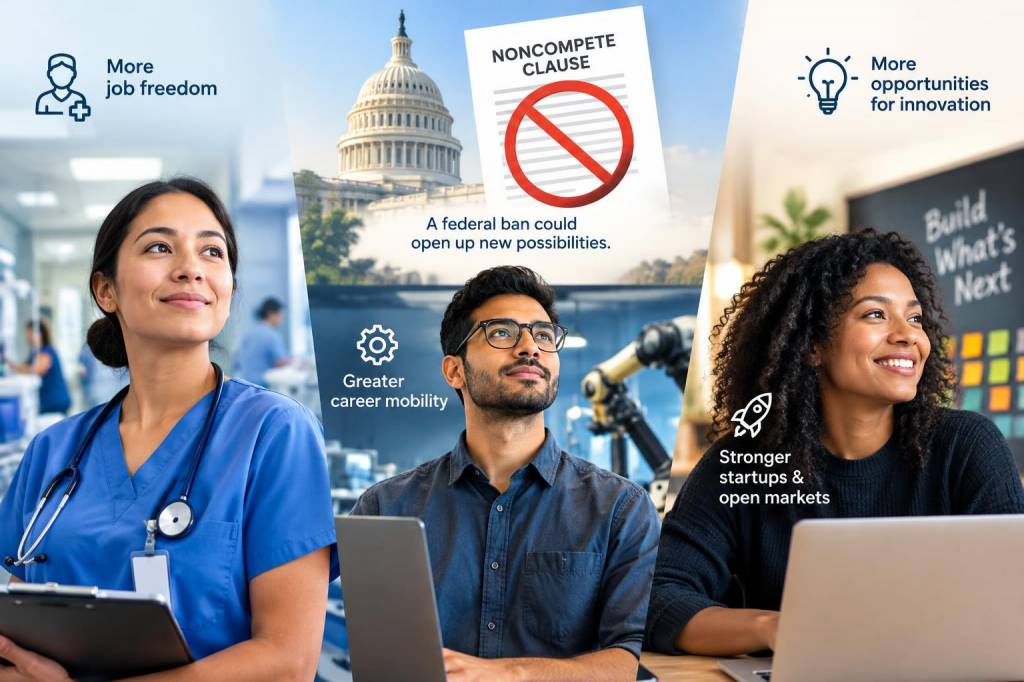
I keep coming back to one simple idea: when a worker signs a job agreement, that paper should help define fair pay, fair duties, and fair limits, not quietly trap a person in place. That is why a federal ban on noncompete clauses feels so important to me. If it survives legal challenges and becomes fully effective, I think it could reshape hiring, pay, mobility, and bargaining power across a lot of fields, especially for nurses, engineers, and startup workers.
Noncompete clauses have been used for years to stop workers from joining a rival company or starting a competing business after leaving a job. In practice, I have seen them do much more than protect trade secrets. They can make people hesitate before changing employers, even when a better role would improve their wages, work-life balance, or career path. For many workers, the clause is less about competition and more about control.
Why this issue matters so much to me
I do not see this as a narrow legal dispute. I see it as a labor market issue with real human consequences. A nurse should be able to move to a better hospital without fearing a lawsuit. An engineer should be able to change jobs without wondering whether a former employer can block months of earning potential. A startup employee should not feel that taking a bold risk inside a small company means giving up future freedom.
When workers can move more freely, employers have to compete harder on pay, culture, benefits, and growth. That matters because wages rarely improve just because a company feels generous. They improve when workers have options. If a federal ban on noncompetes limits employer lock-in, I think it could force a healthier kind of competition: not for legal restraints, but for talent.
What could change for nurses
Nurses are one of the clearest examples of why noncompetes can be harmful. In many places, health systems and staffing firms have used these clauses to stop nurses from moving to nearby hospitals, outpatient clinics, or home-care employers. That can be especially difficult in regions where one health network controls a large share of the local market.
From my perspective, this is not only about job hopping. It is about access to care. When a nurse cannot move easily, a hospital may keep staff longer than it otherwise could, but patients may also feel the effects through staffing shortages, stress, and burnout. If nurses can switch jobs more freely, employers may have to offer safer schedules, stronger benefits, and better retention support.
I also think this could help experienced nurses gain leverage. A nurse with specialized skills in emergency care, intensive care, or operating rooms should not have to accept weak conditions simply because a restrictive contract makes leaving painful. More freedom could mean more pressure for fair compensation in a profession that already carries intense responsibility.
What could change for engineers
Engineers often work with code, product roadmaps, hardware designs, and technical know-how that companies want to protect. I understand that concern. A business has a legitimate interest in safeguarding confidential data and trade secrets. But a broad noncompete often goes far beyond that goal. It can prevent an engineer from joining another firm in the same city or even in the same sector, regardless of whether any real secret is at risk.
That restriction matters because engineering careers are built on momentum. The fastest way to learn is often by moving into a new environment, solving new problems, and taking on more responsibility. If a federal ban weakens noncompetes, I expect more engineers to negotiate from a stronger position, especially in fields like artificial intelligence, cloud services, semiconductors, robotics, and cybersecurity.
I also think startups could benefit. When engineers know they can leave without facing an aggressive legal threat, they may be more willing to join younger companies in the first place. Startups often need talent that is both skilled and willing to take a risk. A less restrictive labor market could make that easier.
There is another side, though. Some companies fear that easier worker movement will make it harder to protect product plans and technical designs. I take that concern seriously. Still, I believe a narrower approach, using confidentiality agreements and real trade secret law, is a better fit than a blanket ban on future employment.
What could change for startup workers
Startup workers live with a different kind of pressure. In a small company, people often wear many hats, move quickly, and build products before there is even a stable business model. They may accept lower pay in exchange for equity, learning, or the chance to be part of something new. That tradeoff can be exciting, but it can also become risky if a noncompete limits what comes next.
I have always thought startup culture works best when it is powered by trust. If a founder asks someone to bet on a new idea, that worker should not later discover that leaving the company means losing access to an entire slice of the industry. A federal ban could give startup employees more room to move between early-stage firms, join larger companies, or launch a company of their own.
That could also change how people value equity. Startup equity often sounds attractive, but if a worker cannot freely move after leaving, the practical value of that upside may feel smaller. Mobility makes equity more meaningful because people can leave with experience, network connections, and future choices intact.
What employers may do instead
If noncompetes weaken or disappear, I expect many employers to rely more on other tools. Some will use stronger confidentiality provisions. Others may tighten non-solicitation agreements, which limit poaching clients or coworkers. Some will improve retention through bonuses, internal promotion tracks, or better schedules.
That shift could actually be healthy. I prefer systems that reward good management over legal lock-in. If a company wants people to stay, it should give them reasons to stay. Better pay, stable hours, real advancement, and respectful leadership are more durable than a courtroom threat.
Of course, not every employer will adapt in the same way. Some may try to draft broader contracts or test the boundaries of what the law allows. I would expect litigation, uncertainty, and a lot of confusion during any transition period. Workers will need clear explanations, and employers will need to update their handbooks, offer letters, and exit processes carefully.
What workers should pay attention to
I think workers should look closely at three things: what their agreement actually says, what state law already allows, and what their employer is trying to protect. A clause that looks harmless may still carry serious consequences if it is written too broadly. If someone is in nursing, engineering, or startup work, it is worth reading every restriction line by line.
| Worker group | Likely effect of a federal ban | Possible employer response |
|---|---|---|
| Nurses | More freedom to change hospitals, clinics, or staffing firms | Stronger retention pay, schedules, and benefits |
| Engineers | Greater mobility across firms and sectors | More confidentiality rules and talent competition |
| Startup workers | More room to move between startups or found new companies | Heavier focus on equity, culture, and internal growth |
I also think workers should keep records of what they build, what they know, and what they are allowed to use after leaving. That is not paranoia. It is practical. The more clearly a worker can separate general skill from confidential material, the safer a career move becomes.
What I think is really at stake
For me, this debate is about whether a modern labor market should reward talent or restrain it. I believe workers should be able to trade skills for better opportunities without being boxed in by outdated contract language. A federal ban on noncompetes would not solve every labor problem, but it could remove one of the most powerful barriers to movement.
It could also force companies to improve from within. When a nurse can leave, a hospital must listen. When an engineer can leave, a company must innovate in a way that respects people. When a startup worker can leave, a founder must earn loyalty instead of demanding it through fear.
And that is the change I care about most: not chaos, not easy turnover for its own sake, but a labor market where freedom is treated as a normal part of work rather than a privilege that only some people can afford.